Skip to content

News

Lumito AB and Katana Labs GmbH sign Letter of Intent and enter into a strategic partnership to enhance biomarker detection and quantification

Lumito AB (publ) (“Lumito” or the “Company”) today announces that the Company and Katana Labs GmbH (“Katana Labs”) have signed a Letter of Intent (“LOI) formalising a strategic partnership to jointly commercialise an end-to-end, ultra-sensitive immunohistochemistry (IHC) workflow that integrates Lumito’s labelling and scanning technology with Katana Labs’ AI-powered image analysis platform. This is a result of the first phase of the collaboration, which was successful, after which the companies now strengthen the commercial collaboration.

“We are excited that we are taking concrete steps towards offering a plug-and-play IHC workflow solution that includes Lumito’s SCIZYS system and Katana Labs’ cloud-native software for AI-powered image analysis and quantification. This will enable our customers to address challenging research questions with a powerful and integrated solution,” says Sanna Wallenborg, CEO of Lumito.

Lumito and Katana Labs will develop and jointly commercialise an end-to-end, ultra-sensitive immunohistochemistry (IHC) workflow that integrates Lumito’s up-converting nanoparticle (UCNP)-based imaging technology with Katana Labs’ advanced AI-powered image analysis platform. The strategic collaboration aims to deliver a fully integrated ultra-sensitive IHC platform for enhanced tissue analysis and reliable biomarker detection, addressing critical unmet research needs in IHC e.g. the detection and quantification of low/ultralow expressed biomarkers such as HER2. Users can implement the end-to-end workflow in-house or access it as scanning-as-a-service.

“This partnership brings together two highly complementary technologies that, together, redefine what’s possible in reliable and robust biomarker detection. By uniting Lumito’s physical detection sensitivity with Katana Labs’ computational intelligence, we are setting a new benchmark for precision oncology and translational research,” says Dr. Norman Gerstner, Chief Business Officer at Katana Labs.

The LOI precedes a non-exclusive agreement under which both parties will continue their independent commercial activities. At the same time, they will collaborate to further validate and promote their combined end-to-end workflow through co-marketing and joint commercialisation efforts. By presenting each other’s solutions in customer meetings and shared presentations, both companies aim to expand market exposure and provide CRO and biopharma R&D customers with an integrated, all-in-one workflow solution, from labeling kit to scanner and cloud-based image analysis.

For further information, please contact:

Sanna Wallenborg, CEO Lumito
E-mail: sw@lumito.se
Ph: +4670-870 01 68

About Katana Labs
Katana Labs is a software engineering and artificial intelligence (AI) company that builds AI-powered and cloud-native software to decode biology in the context of complex diseases. Katana Labs develops best-in-class deep learning models for the automated analysis of large image datasets. These models are designed to meet the specific needs of various applications in advanced histopathology and tissue analysis, including accurate cell segmentation, biomarker quantification, and multidimensional data extraction. Made readily available through Katana Labs’ cloud platform, R&D teams can easily explore, analyse, and collaborate on whole slide images and tissue microarrays directly via a browser-based interface. By automating time-consuming processing, segmentation, and bioinformatics tasks, Katana Labs’ AI platform enables researchers and clinical scientists to enhance workflow efficiency and productivity.

About Lumito
Lumito specialises in medical technology and translational research in digital tissue imaging. Lumito offers a groundbreaking, highly sensitive imaging technique to locate and measure protein biomarkers in tissue samples using up-converting nanoparticles (UCNPs) through its patented research platform. The technology combines image data with precise biomarker detection, enabling images with higher contrast where irrelevant background information is filtered out. The technique can enhance the analysis of tissue samples by increasing objectivity, thereby contributing to research for more quantifiable diagnoses and optimised treatments. Lumito primarily focuses on drug development and digital pathology and is a spin-off from a research group at Lund University’s Department of Atomic Physics and Laser Center. www.lumito.se/en/

The share is traded on NGM Nordic SME under the name LUMITO, and Mentor is Mangold Fondkommission.
𝐀𝐝𝐯𝐚𝐧𝐜𝐢𝐧𝐠 𝐬𝐩𝐚𝐭𝐢𝐚𝐥 𝐛𝐢𝐨𝐥𝐨𝐠𝐲 𝐢𝐬 𝐚 𝐭𝐞𝐚𝐦 𝐞𝐟𝐟𝐨𝐫𝐭 – 𝐊𝐚𝐭𝐚𝐧𝐚 𝐄𝐝𝐠𝐞 𝐞𝐦𝐩𝐨𝐰𝐞𝐫𝐬 𝐑&𝐃 𝐭𝐞𝐚𝐦𝐬 𝐦𝐚𝐱𝐢𝐦𝐢𝐳𝐢𝐧𝐠 𝐭𝐡𝐞𝐢𝐫 𝐩𝐫𝐨𝐝𝐮𝐜𝐭𝐢𝐯𝐢𝐭𝐲

𝐒𝐩𝐚𝐭𝐢𝐚𝐥 𝐛𝐢𝐨𝐥𝐨𝐠𝐲 is a rapidly evolving field, propelled by interdisciplinary and international collaboration among experts in life sciences, translational research, and biopharma R&D.

Unlocking the wealth of data hidden within these stunning images requires true interdisciplinarity. Pathologists, immunologists, microscopists, and image and data analysts must work together to gain deep insights. However, collaborating on the same image datasets across different sites and organizational boundaries remains a significant challenge.

That is why we built 𝐊𝐚𝐭𝐚𝐧𝐚 𝐄𝐝𝐠𝐞 at Katana Labs. Real breakthroughs in clinical research, biomarker development, and biopharma R&D happen when cross-disciplinary experts 𝐰𝐨𝐫𝐤 𝐚𝐧𝐝 𝐭𝐡𝐢𝐧𝐤 𝐭𝐨𝐠𝐞𝐭𝐡𝐞𝐫, ideally in real-time. With 𝐊𝐚𝐭𝐚𝐧𝐚 𝐄𝐝𝐠𝐞, R&D teams can seamlessly and securely collaborate on spatial omics image datasets within their organization but also with their external collaboration partners or clients. Whether running a global CRO project or coordinating a biotech R&D pipeline, 𝐊𝐚𝐭𝐚𝐧𝐚 𝐄𝐝𝐠𝐞 brings all stakeholders together in a single intuitive, AI-powered cloud-platform.

Because 𝐊𝐚𝐭𝐚𝐧𝐚 𝐄𝐝𝐠𝐞 is 𝐜𝐥𝐨𝐮𝐝-𝐧𝐚𝐭𝐢𝐯𝐞 and 𝐛𝐫𝐨𝐰𝐬𝐞𝐫-𝐛𝐚𝐬𝐞𝐝, there is:
✅ 𝐍𝐨 𝐢𝐧𝐬𝐭𝐚𝐥𝐥𝐚𝐭𝐢𝐨𝐧, 𝐧𝐨 𝐥𝐨𝐜𝐚𝐥 𝐬𝐞𝐭𝐮𝐩, 𝐚𝐧𝐝 𝐧𝐨 𝐈𝐓 𝐨𝐯𝐞𝐫𝐡𝐞𝐚𝐝: just open your browser and start working.
✅ 𝐄𝐟𝐟𝐨𝐫𝐭𝐥𝐞𝐬𝐬 𝐜𝐨𝐥𝐥𝐚𝐛𝐨𝐫𝐚𝐭𝐢𝐨𝐧: easily and instantly share whole-slide images, ROIs, annotations and AI-based analysis results with colleagues or clients around the globe using deep links.

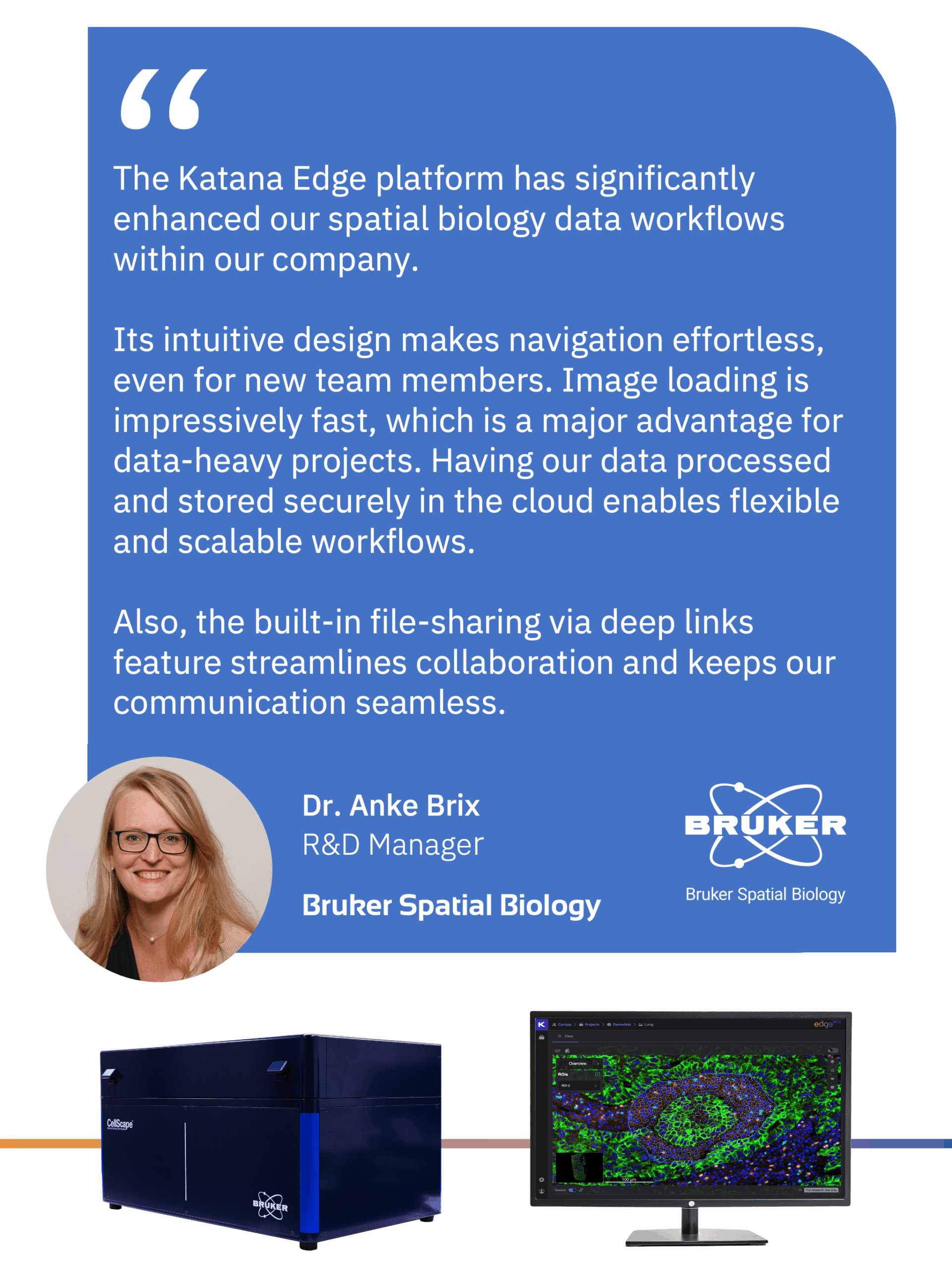
🌟 𝐓𝐞𝐬𝐭𝐢𝐦𝐨𝐧𝐢𝐚𝐥 𝐛𝐲 𝐨𝐧𝐞 𝐨𝐟 𝐨𝐮𝐫 𝐮𝐬𝐞𝐫𝐬:
Dr. Anke Brix (R&D Manager at Bruker Spatial Biology)

In spatial biology, efficiency matters! Benefit from spatial omics image analysis in minutes instead of months.

Working with large digital histopathology and multiplexed image data is becoming standard practice in biopharma R&D and clinical research. These images contain millions of cells labeled for numerous proteins and/or transcripts at once. This data is rich of deep insights waiting to be uncovered and translated into actionable biomarkers, targets and drug candidates.

But there are bottlenecks: Most R&D teams still rely on complicated and outdated workflows, struggling to decode the information from large image datasets. Software has to be installed locally or configured and maintained on on-premise servers. IT teams spend a lot of time setting up infrastructure for compute, network and storage while scientists are waiting and loosing time. Moreover, collaboration across CROs, pharma, and biotech partners is slowed down by outdated local systems and incompatible tools.

The economic implications are detrimental:
⏳ Projects are delayed by weeks or even months before advanced analysis provides conclusive results
💸 High IT costs for infrastructure, licensing, and maintenance stress R&D budgets
🔄 Fragmented workflows create friction instead of collaboration

➡️ The combined effects result in time-consuming, costly and frustrating R&D iterations, which hinders the efficient development of novel targeted therapies.

At Katana Labs, we do not accept that status quo. That’s why we built Edge: an AI-powered, cloud-native platform that brings spatial multiomics analysis directly into your browser.

🚀 With Edge, your workflow improves significantly:
✔️ Immediate access to image visualization, exploration and data analysis through standard web browsers

✔️ No installations, no server setups, no upfront invests, no hidden IT costs

✔️ Share images and results with colleagues or customers anywhere in the world

🔬 For our partners in CROs, biotech, and pharma, this means:

  • Faster biomarker discovery → spend time on science, not on IT bottlenecks
  • Accelerated drug development → results delivered sooner, decisions made faster
  • Reduced costs → scale analysis flexibly without scaling your IT budget

💡 The future of spatial multiomics isn’t locked in local PCs or server rooms. It’s cloud-native. And it runs in your browser instantly and independently of your local infrastructure.

👉 Let’s connect if you want to save time, cut costs, and accelerate your path to breakthrough discoveries.

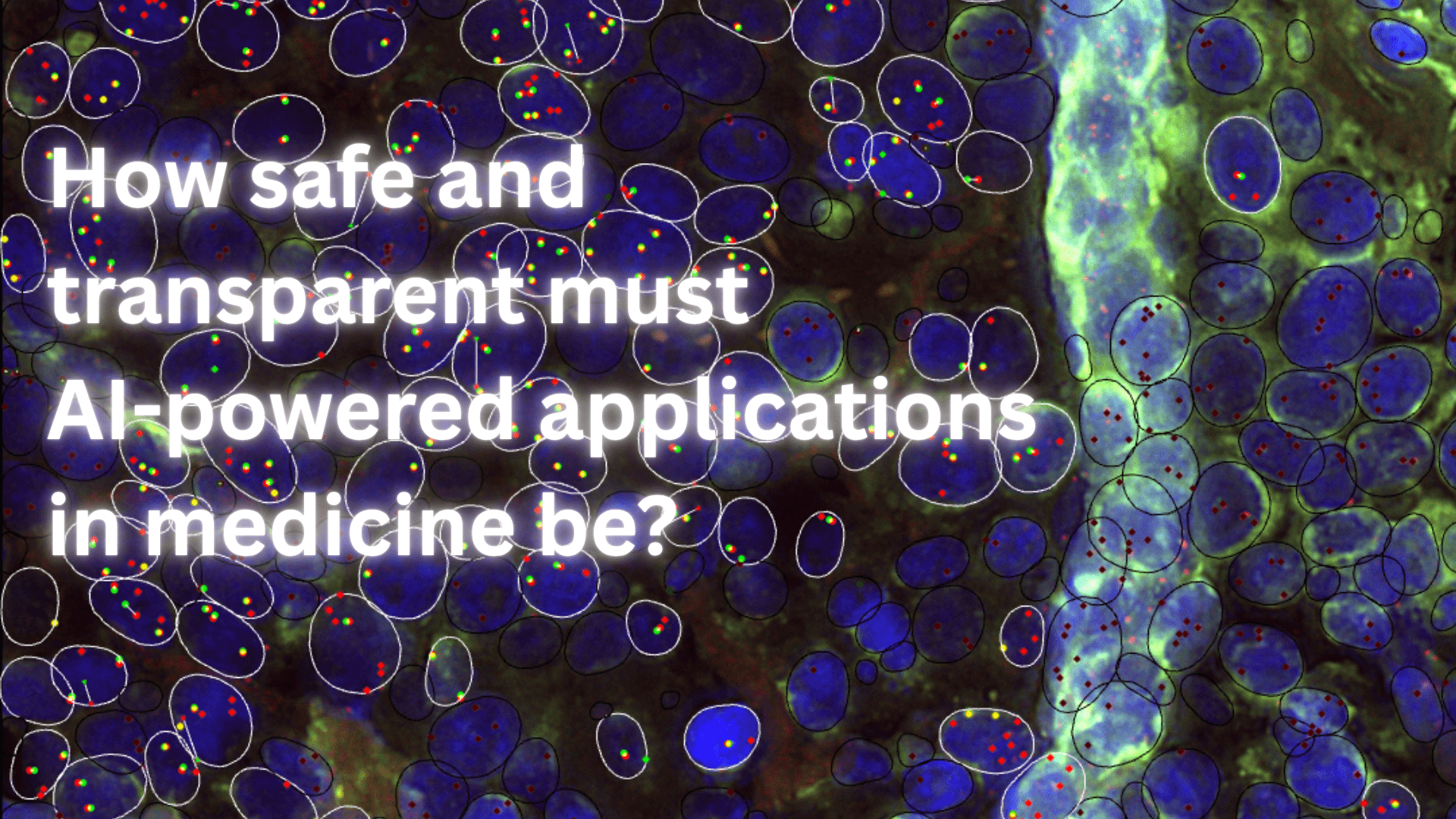
trustPAIKON: Trustworthy AI for Cancer Analysis 

In clinical practice, the highest level of precision is essentiell. The rapidly expanding knowledge of biological processes and relevant biomarkers demands ever-increasing expertise from medical professionals. Artificial intelligence (AI) can provide critical support by automating time-consuming routine tasks, especially in complex, image-based cancer diagnostics, thereby enabling faster, more accurate and more precise results. This marks a significant advancement for personalized precision medicine. 

For AI to become a truly reliable tool in medical workflows, it must deliver not only correct results but also transparent, traceable and quantifiable levels of confidence. It is not sufficient for an algorithm to simply perform an analysis and output a result. Clinicians must also understand how trustworthy that result is. Key questions must be answerable: How reliable is this output? Which algorithmic parameters influenced it, and how were they weighted? Only when such information is available in a transparent and interpretable manner can AI be responsibly integrated into everyday clinical practice. 

This is precisely where trustPAIKON comes in. The project focuses on developing methods for quantitative assessment and visualization of uncertainty in AI-assisted image analysis. In collaboration with the Helmholtz-Zentrum Dresden-Rossendorf (HZDR), Katana Labs is pioneering novel techniques for uncertainty estimation in deep learning models, directly integrated into the PAIKON platform. 

Katana Labs’ PAIKON platform supports pathologists in the digital analysis of histopathological tissue samples. trustPAIKON enhances this platform with robust uncertainty indicators for image analysis, enabling precise and transparent instance segmentation of tumor structures and cells, accompanied by clear information about the confidence level of each individual AI-assisted decision. 

Beyond the medical domain, trustPAIKON also aims to develop generalizable methodologies and modular, reusable software components for AI models. These components can be applied across other safety-critical and highly regulated fields where the reliability and interpretability of AI decisions are essential. 

With trustPAIKON, we aim to establish a foundation for explainable, robust, and responsibly deployable AI in medical diagnostics. 

Project duration: October 2024 until September 2026 
Project leads: Dr. Peter Steinbach (HZDR) and Dr. Walter de Back (Katana Labs) 

This project is supported by the SAB and funds from the ESF European Social Fund.