

Biological Intelligence from Spatial Omics
Katana Labs assists biopharma R&D teams in analyzing and understanding spatial omics data – from raw data to complete results interpretation – within the context of translational projects and clinical study endpoints.
Accelerated research. Better decisions. Improved Outcomes.
AI-native image analysis
Bring your data, expertise, and biological questions.
Collaborate with our Agent which contributes domain-specific knowledge and tools to assist you in navigating and understanding your data.
Upload images. Explain your goal. Start discovering.

- Which cell types are enriched in the tumor core?
- Which cell type has the highest fraction of proliferating cells?
- Which region has the highest mean expression of PD-L1?
How can I help you with your spatial omics workflow today?
Biological intelligence: Three questions your spatial data should answer.
Spatial Omics only creates value if it answers three questions:
How reliable is the data?
Which metrics link molecular features and cell function to tissue architecture?
What biological conclusions can be derived from the data?
Katana Labs combines advanced AI with intuitive software and long-standing scientific expertise to answer all three questions – enabling your team to progress from raw data to the evidence that drives informed decisions.
The challenge has changed
Multiplex imaging, spatial proteomics, and spatial transcriptomics generate datasets of increasing size and complexity. The bottleneck is no longer generating the data. The challenge lies in understanding and interpreting spatial omics data, consistently, at scale, and in a form R&D teams can review and defend.
R&D teams need to:
- Benefit from readily available workflows to process and analyze large whole-slide images (WSIs) and tissue microarrays (TMAs)
- Ensure consistent analysis across cohorts, sites, and studies
- Keep AI-generated results reviewable and biologically plausible
- Translate results into evidence that is suitable to answer translational and clinical questions
KATANA Labs is your trusted partner to gain biological insights from spatial omics data.
From multidimensional data to informed decisions
The KATANA edge platform provides the data management, compute, and analysis infrastructure in one integrated software environment. If you prefer to use the platform independently or outsource your analysis tasks to us, we will support the complete process from raw data to interpretation-ready results.
AI-native platform
Automate and scale spatial image analysis through browser-based workflows designed for large, multidimensional tissue datasets.
Scientific expertise
Work directly with specialists in image analysis, machine learning, computational biology, and spatial tissue profiling.
Decision-ready results
Receive standardized outputs, transparent workflows, and reports designed to support your next research decision.
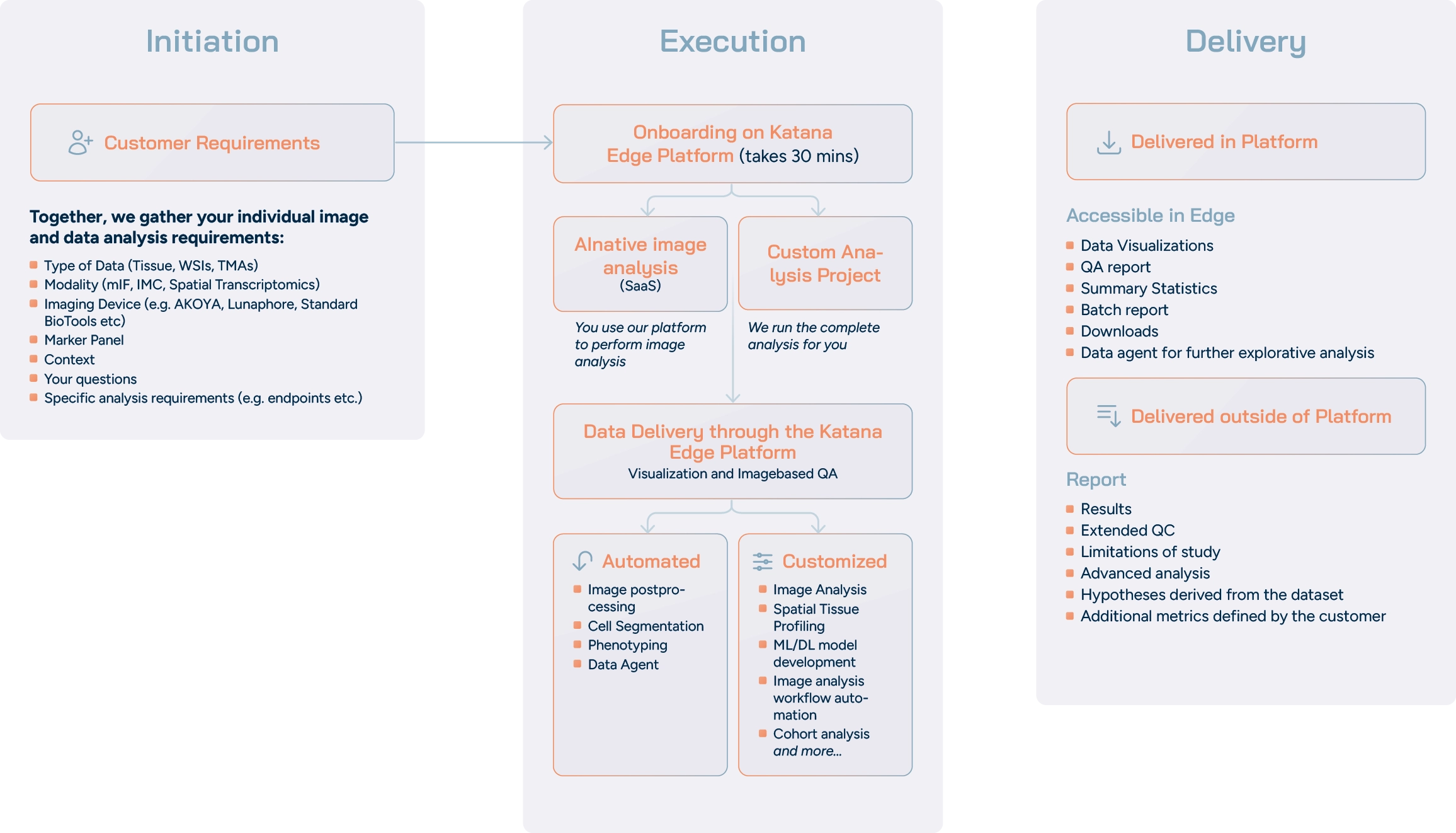
What changes with KATANA Labs
Katana Labs minimizes the technical and analytical effort required between data acquisition and scientific interpretation. This allows your team to focus entirely on answering the questions that truly advance your R&D programs.
Access insights faster
Automated workflows reduce the time and manual effort needed to process, segment, quantify, and explore complex spatial datasets.
Build a stronger basis for decisions
Scientifically grounded models, integrated QA/QC, transparent analytical workflows, and reviewable results support confident research decisions.
Standardize your workflows
Apply consistent analysis pipelines across samples, cohorts, studies, sites, and imaging platforms.
Scale your research without scaling technical overhead
Process large whole-slide images and cohort-scale datasets in the cloud — without dedicated servers, GPUs, or software installations.
Purpose-built to advance your R&D programs
Katana Labs offers comprehensive support for spatial tissue profiling, ranging from translational research to clinical development. Three areas in which our platform and custom analysis services generate the greatest value:
Built around your scientific questions
Biomarker Development
From exploratory signals to significant spatial patterns and reproducible composite marker profiles, we support your biomarker discovery and validation programs. Create contextual information from tissue samples – connecting molecular features with cell function and tissue architecture – then validate it across samples, cohorts, and studies.
Translational research and treatment response
Connect tissue biology to translational decisions. Characterize disease biology, treatment response, and tissue-level mechanisms by combining single-cell measurements with their spatial and histopathological context.
Cohort-scale spatial analysis
Consistent analysis across entire cohorts and studies. Compare biological patterns across samples, cohorts, sites, and imaging platforms — without rebuilding the workflow for each study.
The technology powering the platform
The AI-native cloud platform for spatial tissue profiling
Built for Spatial Omics data analysis.
Katana Edge provides the data management, compute, and analysis infrastructure in one integrated software environment. Easily accessible through a browser-based web application – while the compute is run in the cloud. Visualizing, analyzing, exploring, and sharing results from spatial omics data has never been easier or more intuitive.
Our custom analysis services complement the platform. Enabled by AI, delivered of the highest quality, and always verified by our dedicated and experienced experts.
Katana Labs is an AI, software engineering and data analytics company based in Dresden, Germany.
We offer Katana Edge, our AI-native platform, combined with expert services for analyzing and interpreting spatial omics datasets.
Katana Edge and our analysis services are tailored to the needs of R&D teams in the biopharmaceutical industry, contract research organizations (CROs), and translational research.
From spatial tissue profiling, to cohort analyses and biomarker development, we facilitate a seamless data-to-understanding process throughout the entire spatial analysis workflow.
Successful partnerships are built on people.
Katana Labs is built around a cross-functional team at the intersection of AI, software development, biology, and medicine. Our scientists and engineers have deep domain expertise in biomedical image and data analysis. If you choose to work with us, you will always have a dedicated person as your direct contact for any questions you may have regarding our platform and services.
Scientific rigor and technical excellence
Advancing spatial omics to a reliable enabling technology for biopharma R&D and clinical applications requires validated methods, consistent workflows, biological plausibility, controlled quality, and reproducible results. Above all, it requires an AI-native data analysis platform to extract the insights deeply embedded in multidimensional datasets.
A future where biological data reaches its full potential and R&D teams gain the insights needed to design new precision therapies.
AI-native image analysis platform
Bring your questions and sample data, we tailor the demo to your requirements and workflow.